Disclosure: This article contains affiliate links. We may earn a commission if you sign up through our links at no extra cost to you. All tools recommended are ones we have personally evaluated. This article is for informational purposes only and does not constitute legal or financial advice.
Starting a business with no money is not only possible for millions of people in 2026; it is now the smarter path.
Only 0.05% of startups ever secure venture capital. Meanwhile, 78% of successful businesses are entirely self-funded — most starting with near-zero capital. The reason is simple: free AI tools, digital marketplaces, and no-code platforms have eliminated the startup costs that once made business ownership inaccessible.
But starting a business with no money requires a completely different approach than starting with funding. The sequence is backward from what most people expect. And most guides get it wrong.
This guide shows you exactly what to do and in what order to go from zero capital to your first paying client, your first $1,000 month, and a real business that grows without debt.
What this guide covers: The truth about starting with no money (including what IS required). 15 business ideas you can start today with $0, the correct launch sequence (most people do this backward). A complete free tools stack worth $500+/month at zero cost. How to get your first client without advertising. The step-by-step 30-day launch plan. When and how to legally formalize your business. How to scale from $0 to $5,000/month without external funding.
Table of Contents
Can You Really Start a Business With No Money?
Yes — with one critical qualification: it depends entirely on what type of business you start.
| Best for a no-money start | Startup Cost | Revenue Timeline | Verdict |
| Service business (freelancing, consulting) | $0 | 1–2 weeks | Best for no-money start |
| Virtual assistant / remote admin | $0 | 1–2 weeks | Best for no-money start |
| Digital products (templates, ebooks, courses) | $0–$10 | 2–6 weeks | Excellent — passive income |
| Affiliate marketing / blogging | $0–$10 | 3–12 months | Good long-term, slow start |
| Print-on-demand store | $0 | 2–4 weeks | Good — zero inventory risk |
| Dropshipping | $0–$29/mo | 2–6 weeks | Good — needs some platform fee |
| Product-based business | $200–$2,000+ | 2–6 months | Not suitable for zero capital |
| Physical location business | $5,000–$50,000+ | 6–18 months | Not suitable for zero capital |
The answer is yes for service businesses and digital products. The answer is no for any business requiring physical inventory, equipment, or a location.
| Key insight from the data: 78% of successful businesses are self-funded from the start. Only 0.05% of startups ever secure VC funding. The average seed round is $2.2 million — 200x what most small businesses actually need to launch. Bootstrapping forces discipline that funded businesses often lack. The constraint of zero capital is frequently an advantage, not a disadvantage. |
The #1 Mistake That Kills No-Money Businesses Before They Start
Building before selling.
This is the single mistake that wastes months and kills the momentum of people who could otherwise have a thriving business.
Here is what building before selling looks like:
- Spending 3 weeks designing a logo
- Building a website before you have a single client
- Creating a full social media presence before you have a product
- Writing a business plan before you have validated demand
- Printing business cards before anyone has asked for one
None of these things generates revenue. All of them feel productive. That is exactly why they are dangerous.
| The correct mental model: When you have no money, your only currency is revenue. Everything that does not directly lead to a paying client is optional until you have one. A business without a customer is a hobby with ambition. Sell first. Deliver. Then build the infrastructure with the money you have earned. |
The correct sequence: Sell → Deliver → Earn → Build. Not: Plan → Build → Launch → Hope.
What You DO Need to Start a Business With No Money
Capital is not the primary requirement. Here is what actually is:
| Requirement | Why It Matters | How to Get It |
| A marketable skill | People pay for what you can do, not what you aspire to do | Inventory your existing skills honestly — most people underestimate what they know |
| A specific problem to solve | Vague offers don’t sell. Specific ones do | Talk to 10 potential clients before you decide what to offer |
| A way to communicate | Email, phone, and a free Zoom account cover 95% of client needs | Use what you already have |
| A way to get paid | You need to receive money from day one | PayPal, Stripe, Venmo, or cash — all free to set up |
| Time and consistency | The real investment in a no-money business is hours, not dollars | Block 2 hours per day minimum — more if you want faster results |
| Tolerance for discomfort | Selling feels awkward. Do it anyway. | Every successful entrepreneur has been uncomfortable selling |
15 Best Business Ideas to Start With No Money in 2026
Every idea on this list can be started today with $0. They are ranked by speed to first revenue.
Tier 1: Start Earning Within 1–2 Weeks
1. Freelance Writing and Copywriting
Write blog posts, website copy, email campaigns, or social media content for businesses. Every company needs words. Most do not have time to write them well.
- Startup cost: $0
- Where to start: Upwork, Fiverr, ProBlogger job board
- Realistic first month: $300–$1,000
- Earning potential: $2,000–$8,000/month within 6 months
- Skills needed: Strong writing, ability to research any topic
2. Virtual Assistant Services
Handle email management, scheduling, data entry, research, customer service, and administrative tasks for busy entrepreneurs and small business owners remotely.
- Startup cost: $0
- Where to start: Upwork, Belay, Time Etc, Facebook VA groups
- Realistic first month: $500–$1,500
- Earning potential: $2,000–$5,000/month
- Skills needed: Organized, reliable, strong communication skills
3. Social Media Management
Create and schedule content for business Instagram, Facebook, LinkedIn, and TikTok accounts. Most small businesses know they need to post consistently and have no idea how or time to do it.
- Startup cost: $0 (use free scheduling tools like Buffer free tier)
- Where to start: Direct outreach to local small businesses, Fiverr
- Realistic first month: $400–$1,200 (charge $300–$600/month per client)
- Earning potential: $3,000–$6,000/month with 6–8 clients
- Skills needed: Content creation, scheduling, basic graphic design with Canva
4. Online Tutoring or Coaching
Teach what you know — academic subjects, languages, instruments, fitness, cooking, business skills, exam prep. You do not need a teaching degree to tutor effectively.
- Startup cost: $0
- Where to start: Preply, Tutor.com, Wyzant, or direct via social media
- Realistic first month: $400–$1,500
- Earning potential: $2,000–$6,000/month
- Skills needed: Expertise in the subject + ability to explain clearly
5. Graphic Design
Design logos, social media graphics, presentations, and marketing materials using free tools like Canva. You do not need Adobe Creative Suite to start. Canva free tier handles 80% of client requests.
- Startup cost: $0 (Canva free tier)
- Where to start: Fiverr, 99designs, local business outreach
- Realistic first month: $300–$800
- Earning potential: $2,000–$5,000/month
6. AI Prompt Engineering and AI Consulting
Help businesses use ChatGPT, Claude, and other AI tools to save time and improve output. This is the fastest-growing freelance category in 2026, and most business owners do not know where to start with AI.
- Startup cost: $0 — use free tiers of AI tools
- Where to start: LinkedIn outreach, Upwork, local business network
- Realistic first month: $500–$2,000
- Earning potential: $3,000–$10,000/month
- Skills needed: Familiarity with AI tools and ability to apply them to business problems
Tier 2: Start Earning Within 2–4 Weeks
7. Affiliate Marketing Blog
Start a blog targeting low-competition keywords in a profitable niche (finance, health, tech, home improvement) and earn commissions when readers click your links and buy products.
- Startup cost: $0–$10 (free WordPress.com or $10 for a domain on Bluehost)
- Revenue timeline: 3–9 months to meaningful income
- Earning potential: $1,000–$10,000+/month once established
- Best for: People willing to invest time before seeing results
8. Print-on-Demand Store
Design T-shirts, mugs, phone cases, and wall art using free tools like Canva, then sell them through Printful connected to a free Etsy shop. You pay nothing until someone orders — Printful prints and ships on demand.
- Startup cost: $0 (Etsy charges $0.20 per listing only after upload)
- Revenue timeline: 2–6 weeks for first sale with active marketing
- Earning potential: $500–$5,000+/month with winning designs
9. Digital Product Creator
Create and sell digital downloads, including resume templates, business plan templates, social media caption packs, budget spreadsheets, printable planners, and educational guides. Create once, sell infinitely.
- Startup cost: $0 (Canva free + Gumroad free tier)
- Revenue timeline: 2–4 weeks from first marketing effort
- Earning potential: $500–$5,000+/month with evergreen products
- Best sellers in 2026: Canva templates, AI prompt libraries, small business templates
10. Bookkeeping Services
Help small businesses track income and expenses and prepare for tax season with free tools. A basic understanding of accounting principles (learnable for free on YouTube in a weekend) is enough to serve solo entrepreneurs and small businesses.
- Startup cost: $0 (Wave Accounting is free)
- Typical rate: $25–$75/hour or $200–$600/month per client
- Earning potential: $2,000–$5,000/month with 5–8 clients
Tier 3: Longer Runway, Higher Ceiling
11. Online Course Creator
Package your expertise into a structured online course and sell it on Teachable, Gumroad, or directly through your email list. The creation time is the only real investment.
- Startup cost: $0 (Teachable free plan, Loom free tier for recording)
- Revenue timeline: 4–8 weeks from launch
- Earning potential: $2,000–$20,000+/month with an engaged audience
12. YouTube Channel or Podcast
Build an audience around your expertise and monetize through sponsorships, affiliate marketing, and your own products. Slower to revenue but the highest long-term earning potential on this list.
- Startup cost: $0 (smartphone camera + free Audacity for audio)
- Revenue timeline: 6–18 months to monetization
- Earning potential: $1,000–$50,000+/month once established
13. Dropshipping
Sell products online without holding inventory. When a customer orders, you purchase from a supplier who ships directly to them. The gap between your selling price and supplier cost is your profit.
- Startup cost: $0–$29/month (Shopify Starter plan)
- Revenue timeline: 2–6 weeks
- Earning potential: $1,000–$10,000+/month
- Key challenge: Finding winning products and suppliers
14. Resume Writing Service
Help job seekers create ATS-optimized resumes, LinkedIn profiles, and cover letters. With millions of people changing jobs annually, demand is constant, and the service is completely digital.
- Startup cost: $0
- Typical rate: $75–$250 per resume
- Where to start: Fiverr, LinkedIn, local Facebook community groups
- Earning potential: $1,500–$4,000/month
15. Cleaning Business (Residential)
As covered in detail in our companion article, a residential cleaning business can be started for under $500 in supplies and generates $3,000–$8,000/month within 6 months.
| Read our complete guide: How to Start a Cleaning Business With No Money.‘ |
The Complete Free Tools Stack — $0/Month in 2026
This is the full toolkit for running a professional business with zero monthly cost. Every tool listed has a genuinely usable free tier.
| Category | Free Tool | What It Does | Paid Upgrade Needed? |
| Design | Canva Free | Create graphics, documents, presentations, social posts | Only for premium templates — free tier handles 95% of needs |
| Accounting | Wave | Invoicing, expense tracking, financial reports | No — completely free forever for core features |
| Gmail (free) | Professional communication + Google Drive 15GB storage | No | |
| Video calls | Zoom Free Tier | Client meetings up to 40 minutes | Only for calls over 40 min |
| Scheduling | Calendly Free | Let clients book calls without email back-and-forth | No — free tier works for solo users |
| Project management | Trello or Notion Free | Track clients, tasks, and deliverables | No for solo or small use |
| Website | Carrd Free | One-page professional website with contact form | No — upgrade ($19/yr) only for custom domain |
| Payments | PayPal / Stripe | Accept client payments online — no monthly fee | No — they charge per transaction only (2.9% + $0.30) |
| AI writing | ChatGPT / Claude Free | Research, drafts, email responses, content creation | Only for advanced features |
| Social scheduling | Buffer Free Tier | Schedule 10 posts across 3 channels | Only for more channels/posts |
| Contract/proposals | Bonsai Free Trial | Client contracts and proposals | Free trial then $17/month — draft manually first |
| Communication | Slack Free | Team or client communication if needed | Create graphics, documents, presentations, and social posts |
| Total monthly cost of this stack: $0. Every tool above is free to use at the level a new business needs. Do not pay for tools until you are earning enough to justify the upgrade. The paid versions of these tools become worth it at $2,000+/month in revenue. |
The Correct Launch Sequence — Step by Step
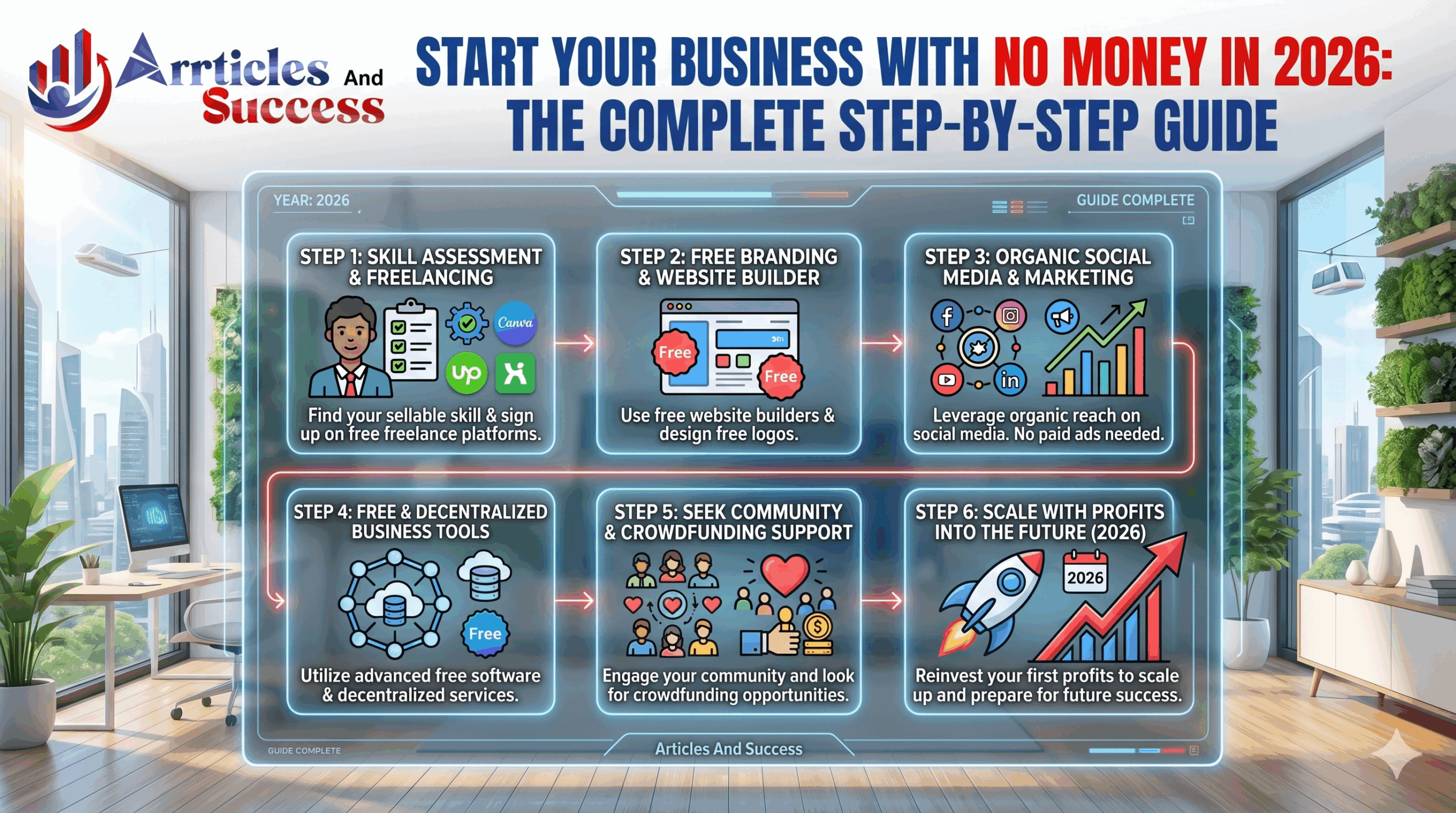
Most guides tell you to plan, build, then launch. When you have no money, this sequence is backward. Here is the correct order:
Step 1 — Identify Your Sellable Skill (Day 1)
Write down every skill you have that someone might pay for. Be specific. Not ‘I write well’ — but ‘I write B2B SaaS blog posts that rank on Google.’ Not ‘I am organized’ — but ‘I manage email inboxes and calendars for busy founders.’
If you are genuinely unsure, ask yourself these three questions:
- What do people already ask for your help with?
- What could you do for 8 hours a day without hating your life?
- What can you do that produces a specific, measurable outcome for someone?
Step 2 — Choose a Specific Target Client (Day 1–2)
The more specific your target client, the easier it is to find them and the higher you can charge. ‘I help small businesses with social media’ loses to ‘I manage Instagram and Facebook for residential real estate agents in Texas.’
Specificity creates trust. Generality creates doubt. Pick a specific client and find them.
Step 3 — Create a One-Sentence Offer (Day 2)
Your offer must answer three things: what you do, for whom, and what outcome they get. Template:
| Offer formula: ‘I help [specific client] achieve [specific result] through [your service].’ |
Examples:
- ‘I help e-commerce brands write product descriptions that convert browsers into buyers.’
- ‘I help coaches and consultants create a month of Instagram content in one day.’
- ‘I help solo founders keep their books clean so they are never stressed about tax season.’
Step 4 — Get Set Up to Receive Payment (Day 2–3)
Before you talk to a single potential client, make sure you can actually get paid. Set up PayPal Business or Stripe — both are free with no monthly fee. You only pay when you earn.
Create a simple invoice template in Wave (free) or in Google Docs, with your name, the client’s name, service description, amount, and your PayPal email. That is all you need.
Step 5 — Do Direct Outreach to 20 People (Day 3–7)
This is the step most people skip because it feels uncomfortable. It is also the only step that directly results in revenue. Do not post on social media and wait. Reach out directly.
- Message 10 people in your existing network who might need or know someone who needs your service
- Post in 3 relevant Facebook groups describing your offer
- Message 5 local businesses on Instagram or Facebook who clearly need your service
- Create a profile on Fiverr or Upwork and list your service
- Answer 2 relevant questions on Reddit or Quora and mention your service naturally
| Reality check: You will get more ‘no’ responses than ‘yes’ responses. That is completely normal. A 10% conversion rate on outreach is excellent. 20 outreaches → 2 interested conversations → 1 paying client is a realistic first-week outcome. Volume and speed of outreach determine speed to revenue. |
Step 6 — Deliver Exceptionally on Your First Job (Week 2)
Your first client is not just paying for a service. They are giving you the foundation of your business: a testimonial, a referral, and proof that your offer works. Over-deliver deliberately.
- Finish 20% before the agreed deadline.
- Include one unexpected extra that costs you time but no money
- Follow up 3 days after delivery to ask if they need anything else
- Ask directly for a written testimonial or Google review
Step 7 — Ask for Referrals (Week 2–3)
The fastest second client always comes from your first client. After delivering exceptional work, ask directly: ‘Do you know anyone else who might benefit from this?’ A warm referral converts at 3–5x the rate of cold outreach.
How to Get Your First Paying Client With No Money
These are the fastest and most reliable methods — ranked by speed and success rate for people starting with no marketing budget.
| Method | Speed to Client | Success Rate | Notes |
| Direct personal network outreach | 1–7 days | High | Fastest method — message people you already know |
| Fiverr profile creation | 2–14 days | Medium-High | Clients come to you — great for creatives and writers |
| Upwork profile + proposal | 2–14 days | Medium | Write highly specific proposals, not generic ones |
| Facebook group posting | 3–14 days | Medium | Post value first, then offer — never spam |
| LinkedIn outreach | 1–14 days | Medium-High | Best for B2B services — highly professional audience |
| Nextdoor / local groups | 3–21 days | Medium | Best for local services — cleaning, tutoring, VA |
| Reddit / Quora answers | 7–30 days | Low-Medium | Best for building long-term credibility |
| Cold email | 7–21 days | Low | Requires research and a very specific pitch |
| Instagram DMs to target clients | 3–14 days | Low-Medium | Works for creative services — lead with value |
| The fastest path to your first client: Step 1: Message everyone you know personally and tell them what you now offer and who you help. Step 2: Post in 3 relevant Facebook groups with a specific, value-first offer. Step 3: Create a Fiverr profile the same day. Do all three simultaneously. First client typically arrives within 1–2 weeks of active effort. |
Your Complete 30-Day Launch Plan
This is the exact daily action plan for your first 30 days. Follow it, and you will have a paying client by the end of week 2.
| Identify your top 3 sellable skills. Choose the one with the highest demand + highest comfort. | Actions | Goal |
| Day 1 | Identify your top 3 sellable skills. Choose the one with highest demand + highest comfort. | Clarity on your offer |
| Day 2 | Write your one-sentence offer. Set up PayPal Business. Create a Wave account. | Ready to receive payment |
| Day 3 | Create a Fiverr profile. Create an Upwork profile. Write your offer description. | Listed on two platforms |
| Day 4 | Message 10 people in your network about your new service. | First outreach batch done |
| Day 5 | Post in 3 relevant Facebook groups. Join 5 more relevant groups. | Community presence established |
| Day 6 | Research 10 potential clients on LinkedIn or Instagram. Write personalised DMs. | Cold outreach in progress |
| Day 7 | Follow up on all Day 4 messages. Send 5 new LinkedIn outreach messages. | Second touch with warm leads |
| Days 8–14 | Send 10 outreach messages per day. Answer 2 Quora/Reddit questions daily. | Momentum building — aim for first client this week |
| Day 14 | First client call or project. OVER-DELIVER on this first job. | First revenue — celebrate this milestone |
| Days 15–21 | Ask first client for testimonial + referral. Continue 10 outreach/day. | Second client incoming |
| Days 22–28 | Set up a simple Carrd website with your offer, testimonial, and contact form. | Professional web presence |
| Day 30 | Review: revenue earned, lessons learned, next 30-day goal. | Assess and iterate |
When to Formalize Your Business Legally
One of the most common questions from people starting with no money is: ‘Do I need to register a business before I can start?’ The honest answer is no.
Here is the legal timeline that actually makes sense:
| Revenue Level | What to Set Up | Cost | Notes |
| $0 — First payment | PayPal or Stripe account | $0 | Can legally earn as an individual before registering |
| $0 — First payment | EIN from IRS.gov | $0 | Free, takes 10 minutes, needed for business bank accounts |
| First $500 earned | Business bank account | $0 | Chime Business or Relay — both free |
| $500–$1,000 earned | LLC registration | $50–$500 | Register once you are earning consistently |
| $1,000 earned | General business license | $100–$200/yr | Required by most cities for any business activity |
| $2,000+/month | Business insurance | $40–$60/month | General liability — important for service businesses |
| $3,000+/month | Accounting software | $15/month | QuickBooks SE for tax tracking — or stay on Wave free |
The key principle: Start earning as an individual. Invest the first $300–$500 you earn into a formal legal setup. Do not spend money you do not have on legal infrastructure for a business that has not yet proven it works.
How to Scale From $0 to $5,000/Month Without External Funding
Scaling a bootstrapped service business follows a predictable pattern. Here is the roadmap:
| Phase | Timeline | Revenue | Key Action |
| Phase 1: First client | Week 1–2 | $100–$500 | Direct outreach — treat this client like gold |
| Phase 2: First month | Month 1 | $500–$1,500 | 3–5 clients via referrals + ongoing outreach |
| Phase 3: Raise prices | Month 2 | $1,500–$3,000 | Charge 25% more to new clients as demand increases |
| Phase 4: Systematise | Month 3 | $2,000–$4,000 | Create templates, processes, and a client onboarding system |
| Phase 5: Scale | Month 4–6 | $3,000–$5,000+ | Add retainer clients (monthly recurring revenue) |
| Phase 6: Hire | Month 6–12 | $5,000–$15,000+ | Hire a subcontractor to take overflow — keep 30% margin |
The biggest lever: Retainer clients. A client who pays you $500/month consistently is worth more than 5 one-off $200 projects. Build toward monthly retainers as fast as possible. By month 3, aim for 50% of your revenue from recurring monthly clients.
People Also Ask — Starting a Business With No Money
What business can I start today with no money?
The fastest businesses to start today with zero capital are freelance writing, virtual assistant services, social media management, online tutoring, and graphic design using Canva. All four can be listed on Fiverr or Upwork within an hour, require zero startup cost, and can generate a first payment within 1–2 weeks. Pick the one that best matches your existing skills and do direct outreach today.
How do I validate a business idea for free?
The best free validation method is a pre-sell: tell 10 potential customers exactly what you plan to offer and at what price, and ask them directly if they would pay for it. If 2 out of 10 say yes and want to know when they can buy, you have validated demand. This takes zero money and one afternoon. A website, logo, and product do not validate a business. Paying customers do.
Can I start a business while working a full-time job?
Yes — and for most people, this is the correct approach. Your full-time job funds your living expenses, removes financial desperation from every business decision, and gives you the stability to build slowly and correctly. The recommended path is to work your business 2 hours per day alongside your employment until it consistently generates 75% of your current salary for 3 months. At that point, leaving is a data-driven decision rather than a leap of faith.
How do I price my services when I am just starting?
Start at a price that feels slightly uncomfortable — not the lowest in your market, not the highest. Research what Fiverr and Upwork listings charge for your service type and set your rate at the middle of the range. Underpricing signals low quality and attracts difficult clients. Raise prices by 20–25% after your first 3 positive reviews. Your prices should increase every 90 days until demand starts to slow—that is the correct pricing ceiling.
How to Start a Business With No Money: Frequently Asked Questions
Can you really start a business with no money?
Yes — service-based businesses, freelancing, consulting, digital products, and affiliate marketing can all be started with zero upfront costs beyond a phone, a laptop, and an internet connection. In 2026, free AI tools, no-code platforms, and digital marketplaces will have eliminated most traditional startup costs. The real constraints are not money — they are time, skill, and the willingness to sell before you build.
What is the best business to start with no money?
The best businesses to start with no money in 2026 are freelance writing ($0 startup, earn from day one), virtual assistant services ($0 startup), social media management ($0 startup), tutoring or coaching ($0 startup), AI prompt engineering ($0 startup), print-on-demand via Printful and Etsy ($0 startup), and affiliate marketing blogging ($0–$10 for a domain). Service businesses are the fastest to revenue. Digital products are best for passive income over time.
How do I get my first client with no money?
The fastest ways to get your first client with no money are: post your service on Fiverr or Upwork for free, message 20 people in your network directly about what you now offer, post in relevant Facebook groups and Nextdoor, offer a discounted first project in exchange for a testimonial, and answer questions on Reddit and Quora in your area of expertise. Your first client comes from personal outreach, not advertising.
What free tools do I need to start a business?
The essential free tools for starting a business with no money in 2026 are Canva for design, Wave Accounting for invoicing and bookkeeping, Google Workspace free tier for email and documents, Zoom free tier for client calls, Trello or Notion for project management, ChatGPT or Claude free tiers for AI assistance, Calendly for scheduling, Carrd for a one-page website, and PayPal or Stripe for payments. Total monthly cost: $0.
Should I quit my job to start a business with no money?
No. Keep your job until your business generates at least 75% of your current salary consistently for 3 consecutive months. Your job is your most important startup asset — it funds your living expenses and removes desperation from your pricing. Starting alongside employment is the safest and most realistic path for most people looking to build a service business.
How long does it take to make money from a business started with no money?
A service-based business can generate its first payment within 1–2 weeks with active outreach from day one. A Fiverr or Upwork profile can land a first order within 48 hours to 2 weeks. Blogging and affiliate marketing take 3–12 months. Digital products typically see first sales within 2–4 weeks of their first marketing effort. Speed to revenue depends entirely on choosing a service business and selling before you build.
Do I need a business license before I can start earning?
No. You can legally earn income as an individual before formally registering a business. Once you are earning consistently, register an LLC ($50–$500 depending on state), obtain a general business license from your city ($100–$200/year), and get a free EIN from IRS.gov. Start earning first. Invest the money you earn into legal formalization.
What is the biggest mistake when starting a business with no money?
Building before selling. Spending weeks on a logo, website, and social media presence before you have a paying client wastes your most valuable resource — time. The correct sequence when you have no money is: sell first, deliver exceptionally, earn, then invest in infrastructure with the money you have made. A business without a paying customer is not a business yet.
The Bottom Line
Starting a business with no money in 2026 is genuinely possible — but only if you choose the right business type and follow the correct sequence.
The businesses that work: service-based, skill-first, digital-native. The sequence that works: sell before you build—the mindset that works: resourcefulness over resources.
Every constraint you feel right now — no capital, no network, no experience — has been overcome by thousands of business owners before you using the same approach described in this guide.
The only thing stopping you from starting today is starting today.
| Your action items for today: 1. Pick one business idea from the 15 above that matches your existing skills. 2. Write your one-sentence offer using the formula in Step 3. 3. Set up a free PayPal Business account. 4. Create a free Fiverr or Upwork profile. 5. Message 5 people in your network about your new service. Do these 5 things today. Not this week. Today. |