Starting a landscaping business in 2026 is one of the most accessible paths to self-employment available — and the market has never been larger.
The US landscaping services industry hit $188.8 billion in 2026, with over 726,000 companies and a compound annual growth rate of 6%. A solo operator can start for as little as $755 in used equipment, land their first client within 3 weeks, and reach $5,000 to $10,000 per month within 6 months of consistent effort. One documented operator, Trevor Kokenge, started with $300 in used equipment and now earns $29,000 per month with just two employees.
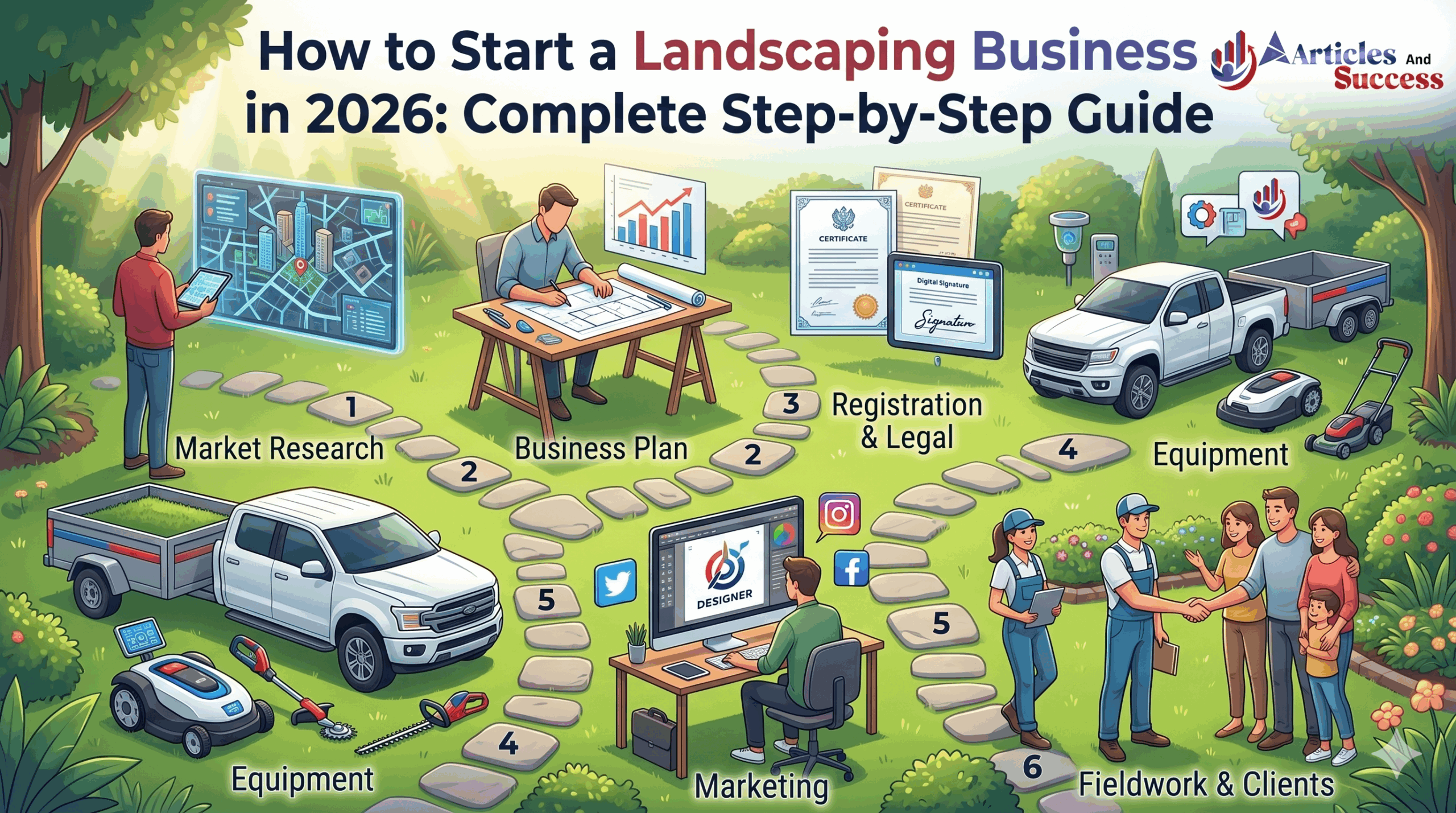
This guide covers every step from choosing your services and buying equipment to pricing, licensing, and landing your first paying clients.
| Quick summary: Start cost: $755–$1,360 (basic) or $3,000–$8,000 (with truck/trailer). Time to first client: 3–4 weeks. Starting price: $45–$75/lawn or $50–$150/flat rate. Solo monthly revenue: $5,000–$10,000, peak season. Industry size 2026: $188.8 billion. Licenses needed: a general business license and liability insurance. Pesticide license if applying chemicals. |
Table of Contents
Table of Contents
- Is a Landscaping Business Worth Starting in 2026?
- Step 1: Choose Your Business Model
- Step 2: Write Your One-Page Business Plan
- Step 3: Check the Market in Your Area
- Step 4: Set Up Your Business Legally
- Step 5: Get Licensed and Insured
- Step 6: Buy Your Starter Equipment
- Step 7: Set Your Prices
- Step 8: Get Your First Clients
- Step 9: Set Up Scheduling, Invoicing, and Payments
- Step 10: Scale to $10,000+/Month
- Seasonal Planning: Managing the Off-Season
- People Also Ask
- Frequently Asked Questions
Is a Landscaping Business Worth Starting in 2026?
The fundamentals are strong. Demand for landscaping is driven by demographics — dual-income households with no time to maintain yards, aging homeowners who cannot do the physical work, and new homeowners who do not own equipment. None of these trends is reversing.
| Strong returns on time Breakeven | Data | What it means for you |
| US industry revenue 2026 | $188.8 billion | Large, fragmented — room for every local operator |
| Number of companies | 726,000+ | Proof the market supports independent operators |
| Annual growth rate | 6% (CAGR 2020–2025) | Consistent demand, not a fad |
| Solo monthly revenue (peak) | $5,000–$10,000 | Full-time viable from season one |
| Startup cost (minimum) | $755–$1,360 | One of the lowest-cost businesses available |
| Time to first client | 3–4 weeks | Faster than almost any other business |
| Profit margins | 18–35% for established operators | Strong returns on time invested |
| Breakeven timeline | 3–6 months typical | Low financial risk |
| Honest caveat: Landscaping is seasonal in most US markets. Revenue concentrates in April through October with 4 to 5 slower winter months. Your business plan must account for this cash flow pattern. Build a 3-month cash reserve before the first slow season hits. |
Step 1: Choose Your Business Model
Your choice of service model determines your startup cost, equipment needs, client type, and revenue pattern. Choose one and focus on it before expanding.
| Operators with a design background | Services | Startup cost | Revenue pattern | Best for |
| Lawn maintenance (recurring) | Mowing, edging, trimming, blowing | $755–$1,360 | Weekly/biweekly — most predictable | Beginners — fastest client acquisition |
| Lawn care (service add-ons) | Fertilization, weed control, aeration, overseeding | $2,000–$5,000 + licenses | Seasonal treatments — higher margin | Operators with pesticide license |
| Landscape design + install | Garden design, planting, mulching, hardscaping | $5,000–$20,000+ | Project-based — higher per-job value | Operators with design background |
| Commercial maintenance | HOA, office parks, schools | $10,000–$30,000 | Monthly contracts — most stable | Experienced operators with a crew |
| Specialty: snow removal | Plowing, salting, snow blowing | $5,000–$15,000 | Winter only — complements summer | Cold-climate operators seeking year-round income |
| Expert verdict: Start with residential lawn maintenance — mowing, edging, and basic cleanup. It requires the least equipment, generates recurring weekly income, and gives you the fastest path to your first client. Add services as demand confirms them. Do not buy specialized equipment before you have confirmed clients who need that service. |
Step 2: Write Your One-Page Business Plan
You do not need a 30-page MBA business plan. You need one page that forces you to answer the decisions that will determine whether your business survives the first season.
- What specific services will you offer this first season?
- Who is your target client? (Residential homeowners in which zip codes? Rental property managers? HOAs?)
- How will you price? (Per-visit flat rate, hourly, or square footage?)
- How will you get your first 10 clients? (Door flyers, Facebook groups, Google Business Profile, referrals?)
- What break-even? (Monthly costs ÷ average job price = jobs needed per week)
- What is your seasonal cash flow projection? (4 to 5 slow months need to be planned for)
| Seasonal cash flow example: If you earn $6,000/month April–October (7 months = $42,000) and need $2,000/month to live, you have $28,000 after living costs for the season. Set aside $8,000–$10,000 during peak season to cover November–March at $2,000/month. StartupOwl recommends including a seasonal cash flow projection in your plan before spending a dollar on equipment. |
Step 3: Check the Market in Your Area
Before registering an LLC or buying equipment, spend one morning validating demand in your specific market. StartupOwl’s practical test: count landscaping trucks in your target zip code between 8 AM and noon. Fewer than 10 trucks means clear room for a new operator. More than 20 means higher competition — differentiate on reliability and communication rather than price.
- Search ‘[your city] landscaping’ on Google — read the 1-star reviews of competitors. These are your differentiation opportunities (common complaints: unreliability, poor communication, missed visits)
- Check Nextdoor and local Facebook groups for ‘looking for a landscaper’ posts — real demand signal.
- Look at competitor pricing on Thumbtack and Angi for your area — set your prices at or slightly above the median, not the cheapest.
Step 4: Set Up Your Business Legally
4a — Form Your LLC
Form an LLC before you take your first payment. You are working on client properties with equipment that can cause property damage or personal injury — personal liability protection is not optional.
- LLC filing cost: $50–$500, depending on your state
- File online at your state’s Secretary of State website or use ZenBusiness ($49) for a handled filing
- Processing time: 2–4 weeks (some states offer same-day expedited filing)
4b — Get Your EIN
Apply for a free Employer Identification Number at IRS.gov — takes 10 minutes online, required for your business bank account, and to hire employees later.
4c — Open a Business Bank Account
Open a dedicated business checking account the day you receive your EIN. Never mix business and personal funds — it makes taxes significantly more complex and makes it impossible to track profitability accurately.
Step 5: Get Licensed and Insured
| Add endorsement to personal policy or get a commercial policy | Cost | Required for | Where to get it |
| General business license | $50–$200/year | All landscaping businesses | City or county clerk’s office |
| LLC registration | $50–$500 one-time | All businesses | Secretary of State website |
| EIN | Free | All businesses | IRS.gov (10 minutes) |
| General liability insurance | $1,100–$3,500/year | All landscaping businesses (required by most clients) | Insurance broker — get 3 quotes |
| Commercial auto insurance | $100–$300/month | Using vehicle for business | Add endorsement to personal policy or get commercial policy |
| Pesticide applicator license | $50–$200 + exam | Fertilization, weed control, pest treatment | State Department of Agriculture |
| Workers’ compensation | Varies — required when hiring | Required in most states when you hire W-2 employees | State workers’ comp board |
Insurance is non-negotiable: General liability insurance costing $1,100 to $3,500 per year is the cheapest protection available for a business operating heavy equipment on private property daily. One property damage claim without insurance ends your business. Get quotes from Hiscox, Next Insurance, or your local broker.
Step 6: Buy Your Starter Equipment
The most common mistake: over-investing in equipment before you have clients to justify it. Start lean. The minimum viable equipment list gets you operational for your first season.
| Equipment | Minimum cost (used) | New cost | Priority |
| Commercial push mower | $150–$300 | $300–$500 | Essential — buy this first |
| String trimmer/weed eater | $80–$150 | $150–$300 | Essential |
| Leaf blower | $60–$100 | $100–$200 | Essential |
| Edger | $50–$100 | $80–$150 | High — clients notice edging quality |
| Hand tools (rakes, shovels, pruners) | $80–$150 | $100–$200 | Essential |
| Safety gear (gloves, goggles, ear protection) | $30–$50 | $50–$100 | Essential — non-negotiable |
| Truck (used, minimum) | $5,000–$10,000 | $25,000–$50,000 | Buy used or rent initially |
| Trailer (used, open landscape) | $800–$1,500 | $2,000–$4,000 | Add once you have 5+ clients |
| Riding mower | $1,500–$3,000 | $3,000–$8,000 | Add only once you have large properties |
Trevor Kokenge’s lesson: Homebase documents how Kokenge started with $300 in used equipment. Most of the equipment on this list is available on Facebook Marketplace and Craigslist at 50-60% below retail. Buy used to start — replace with commercial equipment as client revenue justifies it.
Step 7: Set Your Prices
Pricing is where most new landscaping businesses damage themselves permanently — by charging too little to win clients, then being unable to raise rates without losing them.
| Use the hourly rate for very large properties | Price range | Notes |
| Lawn mowing — small yard (under 5,000 sq ft) | $40–$65 per visit | Bread-and-butter service — price by local market |
| Lawn mowing — medium yard (5,000–10,000 sq ft) | $60–$100 per visit | Add travel time to pricing for distant clients |
| Lawn mowing — large yard (10,000+ sq ft) | $100–$200 per visit | Use hourly rate for very large properties |
| Hourly rate | $45–$75 per hour | Use for complex or undefined jobs |
| Edging and trimming (add-on) | $15–$30 on top of mowing | Usually bundled — itemize for upsell clarity |
| Leaf removal (per visit) | $75–$300 depending on yard size | Seasonal — high value per hour |
| Mulching (installed) | $75–$150 per yard of mulch | Include delivery and installation |
| Hedge trimming | $50–$200 depending on size/quantity | High skill perception — charge well |
| Seasonal cleanup (spring/fall) | $150–$500 per cleanup | One-time high-value service |
| Aeration + overseeding | $150–$300 per lawn | Requires equipment — add after year one |
| Pricing formula: Your hourly target rate should be: (desired annual income + annual business costs) ÷ billable hours per year. Example: $60,000 desired income + $15,000 business costs = $75,000 needed. At 30 billable hours per week × 26 peak weeks = 780 hours. $75,000 ÷ 780 = $96/hour minimum. Set your per-lawn rates to achieve this or higher. |
Step 8: Get Your First Clients
This is the step that separates businesses that grow from those that stall. You do not need a website, uniform, or vinyl wrap on your truck to get your first 10 clients. You need visibility and a reputation for showing up reliably.
Method 1: Door-to-Door Flyers (Fastest)
Print 500 door hangers ($50–$80 at VistaPrint) and distribute them in neighborhoods matching your target client profile. Include your service list, price range, license status, and a QR code in your Google Business Profile. Expect 1 to 2 yeses per 100 doors — 500 flyers typically generate 5 to 10 client inquiries.
Method 2: Google Business Profile (Highest Long-Term ROI)
Set up a free Google Business Profile the same week you register your LLC. Over 80% of people looking for a landscaper start their search on Google first. A completed profile with 5+ photos and 5+ reviews puts you on the map — literally — for local searches.
- Add your business name, service area, phone, and hours
- Upload 8–10 photos of your equipment, your work, and yourself
- Ask your first 5 clients for a Google review — offer $10 off their next visit
Method 3: Nextdoor and Local Facebook Groups
Post in every local Facebook group and Nextdoor community in your service area with a brief, professional introduction. Include your insurance status, your starting price, and a before/after photo if available. Respond within 30 minutes to every inquiry — speed of response is the #1 factor in winning local service jobs.
Method 4: Referral Program
Offer every current client a $25 credit for every new recurring client they refer. Referral clients convert faster, cancel less often, and refer more clients themselves. By month 3, referrals should represent 30% or more of your new client acquisitions.
Step 9: Set Up Scheduling, Invoicing, and Payments
A spreadsheet and cash payments work for your first 5 clients. By client 10, you need software.
| Tool | Cost | What it does | Best for |
| Jobber | $49/month | Scheduling, invoicing, CRM, route optimization | Solo to small team — best overall |
| Housecall Pro | $49/month | Job management, automated reminders, GPS | Growing teams |
| LawnStarter (marketplace) | Commission-based | Connects you with clients — no marketing needed | New operators without a client base |
| QuickBooks SE | $15/month | Income tracking, quarterly tax estimates | Tax management |
| Wave Accounting | Free | Basic invoicing and expense tracking | Earliest stage — upgrade to Jobber at 10+ clients |
| Google Calendar | Free | Basic scheduling only | Absolute minimum — outgrown quickly |
Step 10: Scale to $10,000+/Month
| Phase | Timeline | Monthly revenue | Key action |
| Phase 1: First clients | Weeks 1–4 | $500–$1,500 | Flyers + Facebook + Google Business Profile |
| Phase 2: 10 regulars | Months 2–3 | $2,000–$4,000 | Referral program + Google reviews |
| Phase 3: Solo capacity | Months 4–6 | $5,000–$8,000 | Systemize with Jobber, raise prices 10–15% |
| Phase 4: First hire | Months 7–12 | $8,000–$15,000 | Hire when turning away work consistently |
| Phase 5: Two crews | Year 2 | $15,000–$25,000 | Add commercial contracts and specialty services |
| Phase 6: Multi-crew operation | Year 3 | $25,000–$50,000+ | Add snow removal for year-round revenue |
When to hire: Hire your first employee when you are consistently turning away work for 3+ consecutive weeks and have enough recurring clients to guarantee at least 25 hours per week of work for a new hire. Do not hire based on optimism — hire based on confirmed, booked demand.
Seasonal Planning — Managing the Off-Season
The off-season is where landscaping businesses either build or break. The operators who thrive in the long term actively plan for it rather than hoping the phone keeps ringing.
- Offer fall and spring cleanup packages—charge $150-$500 per cleanup for leaf removal, bed preparation, and gutter cleaning.
- Add snow removal in cold climates — the same clients who hire you for lawn care will pay $75 to $200 per visit for snow plowing and salting.
- Use slow months for marketing: update your Google Business Profile, ask for reviews, send holiday cards to clients, and distribute spring flyers in February.
- Set aside 20 to 25% of peak-season revenue specifically for off-season living expenses. Shopify recommends this as the single most important financial habit for seasonal business owners.
- Consider hardscaping projects (patio installation, retaining walls) during slow periods; these are higher-margin and weather-dependent rather than season-dependent
People Also Ask — How to Start a Landscaping Business
How profitable is a landscaping business?
A landscaping business is highly profitable relative to startup costs. Only operators typically achieve net profit margins of 18-35%. On $6,000 per month in revenue, that represents $1,080 to $2,100 in monthly profit after all expenses. With a crew of 2 to 3 employees, achievable monthly revenue is $15,000 to $25,000, with similar margin percentages. Profitability depends heavily on pricing correctly from the start. Operators who underprice initially often struggle to raise rates without losing clients.
How long does it take to make money landscaping?
Most new landscaping businesses land their first paying client within 3 to 4 weeks of active marketing — door flyers, Facebook groups, and Google Business Profile together typically generate the first 5 clients within a month. Reaching $5,000 in monthly revenue typically takes 4 to 6 months of consistent operations. The operators who grow fastest combine door-to-door canvassing with a strong Google Business Profile and an active referral program.
Do landscaping businesses need a lot of equipment?
A minimal viable landscaping business requires only a push mower ($300–$500), string trimmer ($150–$300), leaf blower ($100–$200), edger ($80–$150), and basic hand tools — total startup cost of $755 to $1,360 at retail or significantly less buying used. You do not need a riding mower, truck, or trailer to start. Many new operators borrow a parent’s truck for the first month while they save for their own equipment from client revenue.
How to Start a Landscaping Business: Frequently Asked Questions
How much does it cost to start a landscaping business?
$755–$1,360 basic (push mower, trimmer, blower, edger, hand tools, safety gear). With used truck and trailer: $3,000–$8,000. Full commercial setup: $15,000–$50,000. Trevor Kokenge famously started with $300 in used equipment and now earns $29,000/month. Start lean and reinvest revenue into equipment upgrades.
Do you need a license to start a landscaping business?
Basic mowing and maintenance typically require only a general business license ($50–$200/year) and general liability insurance. Pesticide application requires a state-issued applicator license. Tree removal over certain heights may require certification. Verify with your state’s Department of Agriculture for pesticide requirements before adding chemical services.
How much can a landscaping business make per year?
Operators typically earn $40,000–$80,000 annually after accounting for the 4-5 slow winter months. Monthly peak-season revenue of $5,000–$10,000 is achievable solo. With one crew, $150,000–$300,000 annually is realistic within 2 to 3 years. The US landscaping market hit $188.8 billion in 2026, with 726,000+ companies — there’s room for new operators in virtually every market.
What equipment do I need to start a landscaping business?
Essential starter kit: commercial push mower ($300–$500), string trimmer ($150–$300), leaf blower ($100–$200), edger ($80–$150), hand tools ($100–$200), safety gear ($50–$100). Total: $755–$1,360 new, significantly less used. Do not buy riding mowers or specialty equipment before confirming client demand for services requiring them.
How do I get my first landscaping clients?
Fastest methods: door-to-door flyers in target neighborhoods (1–2 yeses per 100 doors), Google Business Profile with photos and reviews, Nextdoor and local Facebook group posts with insurance status disclosed, and a $25 referral bonus to existing clients. The first client typically arrives within 3 weeks of active effort.
Is a landscaping business profitable?
Yes — 18 to 35% net profit margins for established operators. $5,000–$10,000 monthly peak-season revenue for solo operators. The keys to profitability: price correctly from day one ($45–$75/hour or $50–$150/lawn flat rate), target 18–35% margins, build recurring clients rather than one-off jobs, and manage seasonal cash flow by saving peak-season revenue for winter months.
When is the best time to start a landscaping business?
Late winter, January to March, is optimal. This gives you time to complete LLC filing, get insurance, buy equipment, and build a client list before spring demand peaks in April. Starting in the spring is still viable. Fall and winter starts allow immediate leaf cleanup revenue while preparing for the main season.
What services should a new landscaping business offer?
Start with: lawn mowing, edging, trimming, leaf removal, and basic garden bed maintenance. These require minimal equipment and generate recurring revenue. Add services as demand confirms them: mulching and hedging (months 2–3), fertilization and weed control (if licensed) (months 4–6), aeration and overseeding (months 6+). Never offer services before having the equipment and expertise to deliver reliably.
Final Thoughts
Starting a landscaping business in 2026 remains one of the most viable paths to self-employment available. The market is large, demand is consistent, barriers to entry are low, and the path from first lawn to full-time income is well-documented.
The operators who succeed share one habit: they start before they feel fully ready. Buy the minimum equipment, get the insurance, knock on the first 100 doors, and learn the business by doing it. Everything else follows from that commitment.
| Your first week checklist: Day 1: File your LLC (ZenBusiness). Day 2: Apply for an EIN at IRS.gov. Day 3: Get a liability insurance quote. Day 4: Buy starter equipment (used, Facebook Marketplace). Day 5: Print 500 door hangers. Day 6: Set up Google Business Profile. Day 7: Distribute the first 100 flyers. The first client typically arrives in weeks 2–3. |